

Review of William Cheung's Wing Chun Kung Fu DVD 3
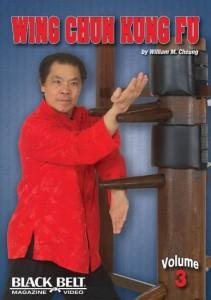
Customer/3rd Party Review: This review was done by a customer/3rd party and is listed here for you reference only. The views and opinions of the reviewer are not those of Everything Wing Chun and do not necessarily reflect EWC's views or opinions on the subject matter. It is posted, like all customer reviews, to give you more info on the product and to give you different opinions on a product so that you can make the best decision for yourself about its content. The review is NOT by an EWC employee or contractor and EWC cannot stand by anything said in any customer/3rd party review. Enjoy!
Review of: Wing Chun Kung Fu by William Cheung – Volume 3
Reviewer: George P Hernandez
DVD Bought on: Everything Wing Chun : http://www.everythingwingchun.com/william-cheung-wing-chun-dvds-books-s/220.htm
Technical Specifications:
- Participants: William Cheung, Eric Oram
- Director: Dan Ivan
- Format: Color, DVD, NTSC
- Language: English, no subtitles.
- Region: 1
- Aspect Ratio: 1.31.1
- Disk: 1
- Length: 59 min
Rating: four on a scale of five or 4:5.
What it's about:
This DVD covers the use of the Wooden Dummy training apparatus or what is known as the Mook Jong of the Wing Chun system. The demonstration of the Wooden Dummy form is jointly performed by Master William Cheung and Sifu Eric Oram. The Mook Jong form consists of 108 classic movements specific to the Wing Chun system, in this DVD its self-defense applications are shown in eleven training sections. The basic and advanced techniques of the Mook Jong are derived from the Si Lim Tao, Chum Kil and the Bil Jee forms and are integrated into the "traditional system" of Wing Chun Wooden Dummy form as promoted by Master William Cheung. The advanced techniques of the Chi Sao system are also covered, which includes a demonstration of the cross hand Chi Sao training scenario.
Comments:
The Wooden Dummy form is demonstrated by William Cheung, in a very fast sequence of hand techniques and footwork. He then follows with the complete sequence showing the form in slow motion. This DVD is an excellent instructional medium that clearly shows how the Wooden Dummy or Mook Jong, becomes a useful tooling in learning the techniques of the Wing Chun system.
One can readily see how important the Wooden Dummy sequence teaches proper foot work, positioning, placement of blocks, balance and the judgment of distance. One's sense of timing, the flow and coordination of technique in using the Wooden Dummy and with its three extended arms, enhance skill development, because it simulates blocks and strikes to the upper, middle and lower gates of an opponent. The Mook Jong, also becomes functional in simulating an opponent's lead leg making it helpful in training for kicks or learning to move toward an opponent's blind side or to position one for leg techniques, which could be effective in the training of foot sweeps and throws.
The student will be able to see and easily learn the Wooden Dummy form and its applications. Master Cheung and Sifu Oram, structured the learning of each sequence by chunking down the form into manageable training sets from its beginning, to its end. They developed eleven training sets of the Wooden Dummy form specifically for this purpose. However, practitioners of other Wing Chun styles might see stylistic differences in the Cheung solo version. For example, the Wooden Dummy form usually begins with a traditional opening somewhat like the first part of Si Lim Tao. William Cheung's version of the Wooden Dummy form dispenses with the traditional opening and immediately proceeds with closing the gap by moving forward with his left leg up and its knee at waist level simulating a leg block or jam to counter a kick. One can easily see the position of the stances or postures exhibited in this version are indeed much wider in foot placement as it is demonstrated by Sifu Oram. It differs slightly in posture from what might be expected or exhibited by someone who had trained in the Wooden Dummy form in Fushun or in Hong Kong, China! Now, does that mean it's wrong…my answer would be an emphatic NO! It's just a different approach! The actual techniques which one sees in the William Cheung, version for other Wooden Dummy forms are essentially the same in sequence and used for the same combative purpose.
In the last instructional section of this DVD, Master Cheung and Sif Oram, demonstrate some of the advance techniques of Chi Sao practice. Cheung emphasizes how important the use of forward pressure is in the double hand Chi Sao. The balance and matching of your partner's forward pressure is crucial in keeping them at their proper distance or outside of one's circle of vulnerability. For example, if one uses too much pressure for instance in a forward direction, up /down or to the side, in a double hand Chi Sao sequence regardless of the hand or technique one is using, it can become a definite disadvantaged. The basic purpose of Chi Sao training is not as a "Rock Em-Sock-Em" drill to see if you can hit the other guy, but it's a method to develop sensitivity, contact and response capability in close quarter combat situations. Learning how to perform the Chi Sao correctly from the beginning is so important and cannot be over emphasized. Master Cheung, in this segment of the DVD begins to set a strong foundation for the Wing Chun student in the Practice of Chi Sao and in the development for advance skills.
The proper position of one's hands and arms is essential in developing skillful technique. For example, Cheung shows how one can use a Lap Sao hand, against an opponent who is using an improper Fook Sao technique, which can leave the opponent without Jet Sao hand protection. He demonstrates how the opponent can be led successfully into a cross hands position, thereby allowing the trapping of both arms at the same time giving one the opportunity to strike at the opponent's head with the free hand.
He also shows the use of covert a hand which comes from underneath one's rolling hand sequence and quickly seizes the opposite arm at the wrist for the beginning of an arm break. He shows also how the hand is used to seize the wrist, while using the elbow that comes over the opponents extended arms. From this position you have several options to strike the opponent, either using the Chuan hand which is free or coming back with a second elbow. He also shows how one can defend against the elbows if such a technique is used.
This DVD is packed with a variety of double hand and cross hand Chi Sao techniques which incorporate kicking strategies while doing the double hand drill. Learning how to effectively use kicks and hand techniques at the same time can befuddle many antagonists. Master Cheung also shows various ways one can use in defending against kicks within close quarters. For those individuals beginning to learn Chi Sao, this DVD presents an excellent opportunity to experience and learn about the diversity of its techniques. This would be an excellent acquisition to anyone's collection on Chi Sao Training.
Content Overview: William Cheung Wing Chun Kung Fu – Volume Three
- Introduction
- `Current Grand Master of the "Traditional System" of Wing Chun Kung FU
- Demonstration of Woody Dummy Techniques – One
- Performed by William Cheung
- Purpose of Woody Dummy Training – Sufi Eric Oren
- Demonstration of Wooden Dummy Technique – Two
- Performed by William Cheung, in Slow Motion
- Wooden Dummy basic hands and kicks narrated by Sifu- Eric Orem
- Explanation of First Set
- Explanation of Second Set
- Explanation of Third Set
- Explanation of Forth Set
- Explanation of Fifth Set
- Explanation of Sixth Set
- Wooden Dummy Applications
- Explanation of Entry Technique
- Explanation of Pac Sao and Palm Strike
- Explanation of Quen Sao and Tan Sao
- Explanation Gum Sao and Lan Sao
- Explanation Huen Sao and Palm Strike
- Explanation of Pac Sao, Bil Sao
- Explanation of Lan Sao - Lower Gate Punch
- Explanation of Bong Sao – Pac Sao - Bil Jee to the eyes
- Explanation of kicks – Lower Gate and Knees
- Explanation of Double Huen Sao
- Explanation of Single and Double Hand
- Huen Sao Combination
- Explanation of Jet Sao, Huen Sao and Plam Strike
- Explanation of Double Gong and Quan Sao
- Explanation of Double Palm Strike From Huen Sao
- Explanation of of Kick/ Punch Defense
- Explanation of Double Gong Sao and Kick
- Explanation of Bong Sao, Elbow Strike, Lao Sao and Palm Strike
- Explanation of the Double Lower Bong Sao to a Tan Sao
- Explanation of Huen Sao to Lan Sao and Palm Strike, Leg Sweep
- Explanation of Bil Sao Combination – Lap Sao and Palm Strike
- Chi Sao Advanced
- Review of Rolling Sequence
- Explanation of Creating an Opening with a Tan Sao
- Explanation of Changing to a Fook Sao from Rolling Sequence
- Explanation of Using Opponents Lack of Forward Pressure
- Explanation of Using Opponents Excessive Pressure to the Outside
- Explanation of Improper Use of the Fook Sao Position
- Explanation of Improper Used of the Bong Sao Position
- Explanation of a Double Elbow Strike From the Rolling Sequence
- Explanation of Countering an Elbow Strike From a Rolling Sequence
- Explanation of Rolling Sequence With Kicks
- Explanation of Rolling Sequence – Kicks, Footwork and Hand Combinations
- Explanation of Rolling Sequence – Blocking Kings With Leg Techniques
other blogs by user